 |
 |

Project Overview
 |
|
Reports Index |
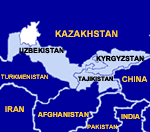
The risks of internal crisis and cross-border violence run high in the region of Central Asia, though they have so far received only scant attention in wider international policy making circles. Three strategic players in the region, Uzbekistan, Tajikistan and Kyrgyzstan, are plagued by a host of internal political and security problems, aggravated by very poor economic and social conditions. In Uzbekistan in particular, the mounting threat of terrorism, allegedly propagated by Islamist extremists, is generally increasing government and regional concern, fuelling fears of a crackdown on political dissent.
Porous and unstable borders, and uncertain security relations between the three states plus Afghanistan have also raised the prospect of inter-state confrontation in the region. International engagement in the region has to date been low-key and relatively inactive, focused principally on humanitarian concerns rather than conflict prevention and security-building measures.
In May 2000, ICG sent an exploratory mission to Uzbekistan, Tajikistan and Kyrgyzstan, following which the Group is now establishing a Central Asia project. This will focus in the first instance on the Ferghana Valley, an economically and strategically significant region of some ten million people, straddling the territories of Uzbekistan, Tajikistan and Kyrgyzstan, and where the three states interact - amid rising political, ethnic and religious tensions.
ICG's first report on the region, Central Asia: Crisis Conditions in Three States (7 August 2000), assesses the prospects of civil unrest and large-scale violence in Tajikistan, Kyrgyzstan and Uzbekistan and recommends appropriate policy responses by the major powers and international organisations.
| [About ICG] - [Projects] - [Contacts] - [Site Guide] [Publications] - [Press Office] - [Home] - [TOP] |